Paeonia Species of the Genus Paeonia
Paeoniaceae Evolutionary Tree (Genus Paeonia)
Click on nodes with ▶/▼ to expand/collapse branches. Tree is expanded to the Subgenus level by default.
Reference:
- Zhou S L, Xu C, Liu J, et al. (2021). Out of the Pan‐Himalaya: Evolutionary history of the Paeoniaceae revealed by phylogenomics. Journal of Systematics and Evolution, 59(6), 1170-1182.
Paeonia suffruticosa
Common Names
- Chinese: 牡丹
- English: Tree Peony
- Scientific: Paeonia suffruticosa
Taxonomy
Eukaryota; Viridiplantae; Streptophyta; Streptophytina; Embryophyta; Tracheophyta; Euphyllophyta; Spermatophyta; Magnoliopsida; Mesangiospermae; eudicotyledons; Gunneridae; Pentapetalae; Saxifragales; Paeoniaceae; Paeonia
Genome References
Yuan J, Jiang S, Jian J, et al. Draft genome of the famous ornamental plant Paeonia suffruticosa.Ecol Evol. 2020;10(11):4518-4530. Published 2020 May 12. Info]
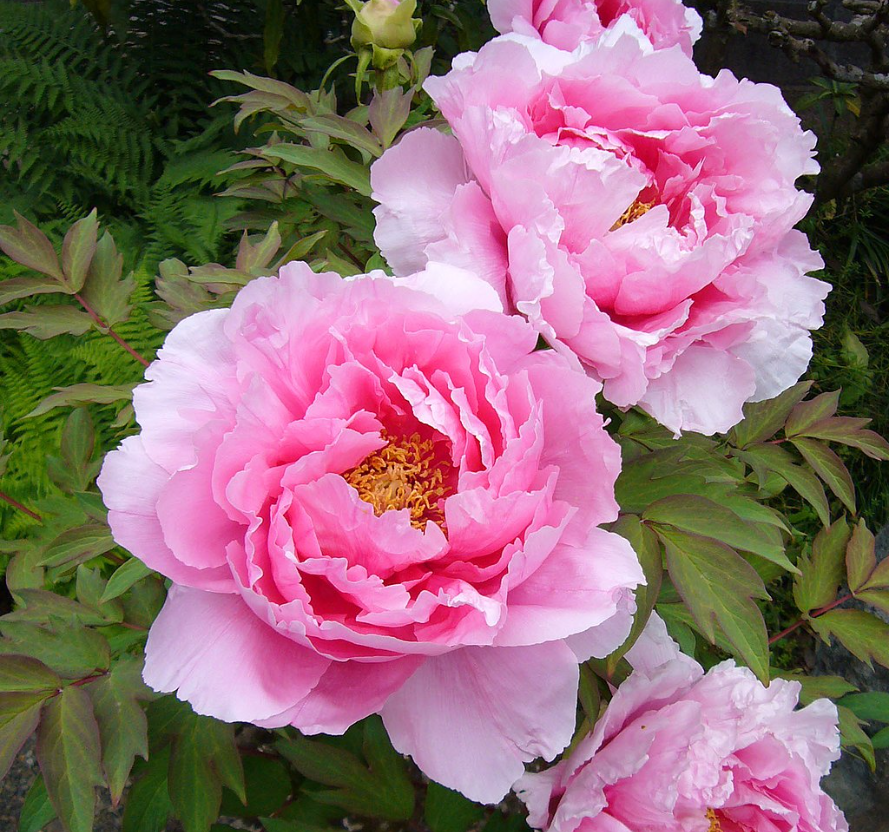
Paeonia suffruticosa plant
Description
Paeonia × suffruticosa is a name used for a group of cultivars of tree peonies that are the result of hybridisation with species exclusively belonging to the subsection Vaginatae. The common name used in China is mǔdān (Chinese: 牡丹). Plants belonging to this group have been cultivated for millennia in China, initially only as a source of traditional Chinese medicine particularly the skin of its roots (牡丹皮; mǔdān pí). Already early on the plant was also cultivated for its ornamental value, and it is highly revered in Chinese culture.
It is a perennial deciduous shrub with stems up to 2 m; The branches are short and thick. Leaves are usually green, pale green, sometimes white, 5-11 cm long. Flowers have petals reddish purple, pink to white. Flowering occurs in May; Fruit in June.
Paeonia ludlowii
Common Names
- Chinese: 大花黄牡丹
- English: Tibetan tree peony
- Scientific: Paeonia ludlowii
Taxonomy
Eukaryota; Viridiplantae; Streptophyta; Streptophytina; Embryophyta; Tracheophyta; Euphyllophyta; Spermatophyta; Magnoliopsida; Mesangiospermae; eudicotyledons; Gunneridae; Pentapetalae; Saxifragales; Paeoniaceae; Paeonia
Genome References
Xiao PX, Li Y, Lu J, et al. High-quality assembly and methylome of a Tibetan wild tree peony genome (Paeonia ludlowii) reveal the evolution of giant genome architecture. Hortic Res. 2023;10(12):uhad241. Published 2023 Nov 10.
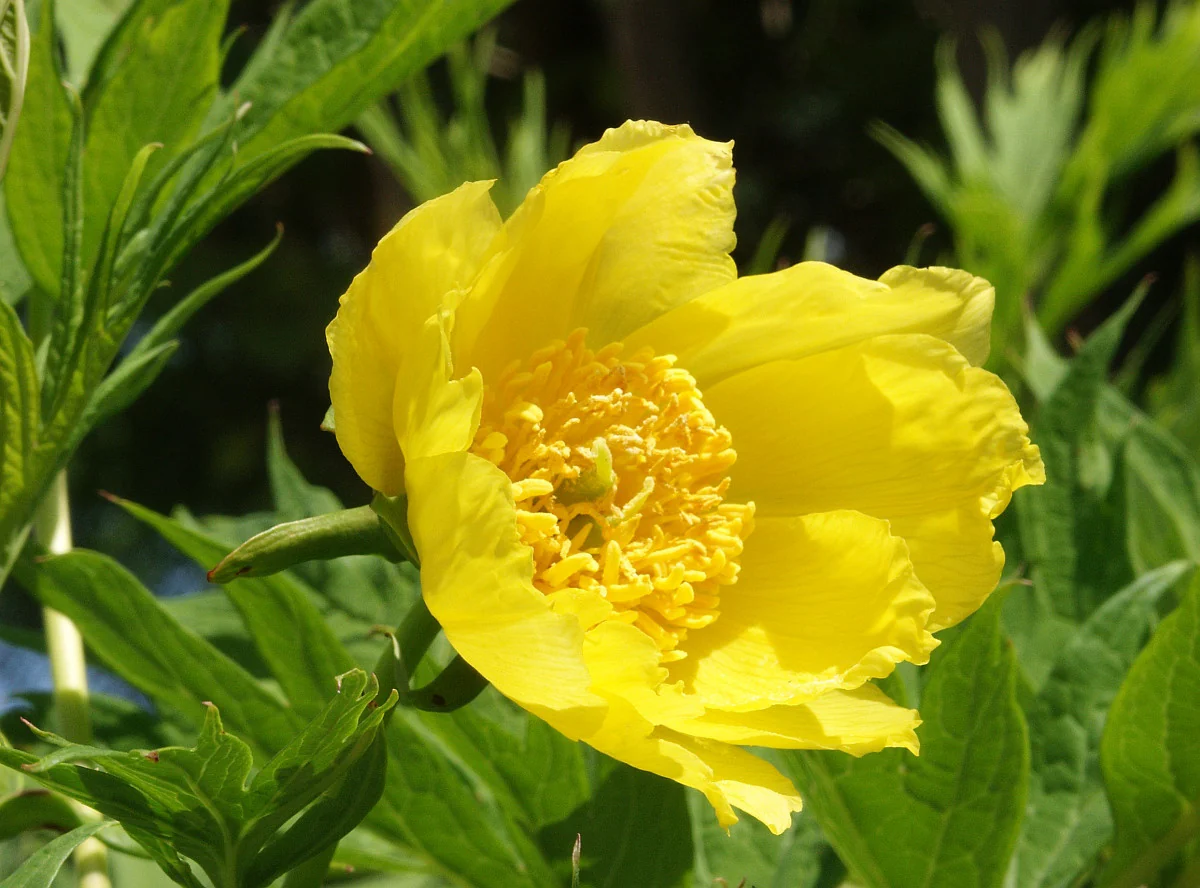
Paeonia ludlowii
Description
The roots taper without fusing. No creeping stems exist. Grey to light brown stems grow in clumps from a gnarled root crown, rarely branch, maintain consistent width, and may reach 4 cm in diameter over years. Young stems are light green with 8–12 basal scales. Leaves are light green above, glaucous below. Lower leaf stalks are 9–15 cm; leaf blades are twice compounded, 6–12 × 5–13 cm, with primary leaflets on 2–3 cm stems, incised nearly to the base into three segments, decurrent along the stalk. Segments are 4–9 × 1.5–4 cm, incised to midlength into three lobes, 2–5 × 0.5–1.5 cm, with entire or slightly toothed margins and pointed tips. Bisexual flowers, slightly nodding, grow 3–4 per shoot from leaf axils, 10–12 cm wide, on 5–9 cm pedicels, blooming late May to early June. Four or five lance-shaped bracts subtend each flower. Green sepals, 1.5–2.5 cm, have rounded tips narrowing to a point. Yellow, egg-shaped petals, 5–5.5 × 2.5–3.5 cm, curve inward with rounded tips. Yellow filaments, 1–1.5 cm, carry 4 mm anthers. A toothed, ring-shaped yellow disk, 1 mm high, surrounds 1–2 carpels with yellow stigmas.